
Skip to content

RN-created tools for real-shift moments

Nursing school taught the concepts. The shift asks for the words.

Short, practical tools for calling a provider, managing competing demands, asking for help, and protecting patient care when the shift gets heavy.

1907 · Med-surg · 4 patients

  • New order, two call lights, and a family at the desk.
  • Provider is waiting on a number you have not looked up yet.
  • You know the material. You need the sentence.
Three nurses in scrubs conferring over notes at a hospital nurses' station
Handoff at the station · the moment the words matter

02 / Why this exists

Built for the moment between knowing and doing.

Most nurses do not freeze because they forgot the pathophysiology. They freeze because three things are happening at once and no one taught them the exact words for the fourth.

Nursing Beyond Theory works on that gap: what you say when you call, what you do first, how you name a limit without abandoning your patients, and how you ask for help early enough for it to matter.

The tools are short on purpose. You should be able to use one before a shift, on a break, or in the ten minutes you have before you pick up the phone.

03 / Inside the tools

What the practice actually looks like.

Three scenarios, and the screens that go with them.

Scenario · 0432

Blood pressure 84/49, patient is drowsy, and you are not sure this is a phone call yet.

SBAR Shift Prep walks you through what the provider will ask for first, what you can still check in two minutes, and how to open the call so the recommendation is not lost at the end.

See SBAR Shift Prep

Nurse in scrubs on the phone at a hospital workstation, reading from her notes
SBAR builder · step 3 of 4

Recommendation

  • I am calling about Mr. R in 412, post-op day one.
  • BP 84/49, HR 112, urine output 15 mL over two hours.
  • I would like you to assess him — or an order for a fluid bolus.
SBAR builder · step 3 of 4
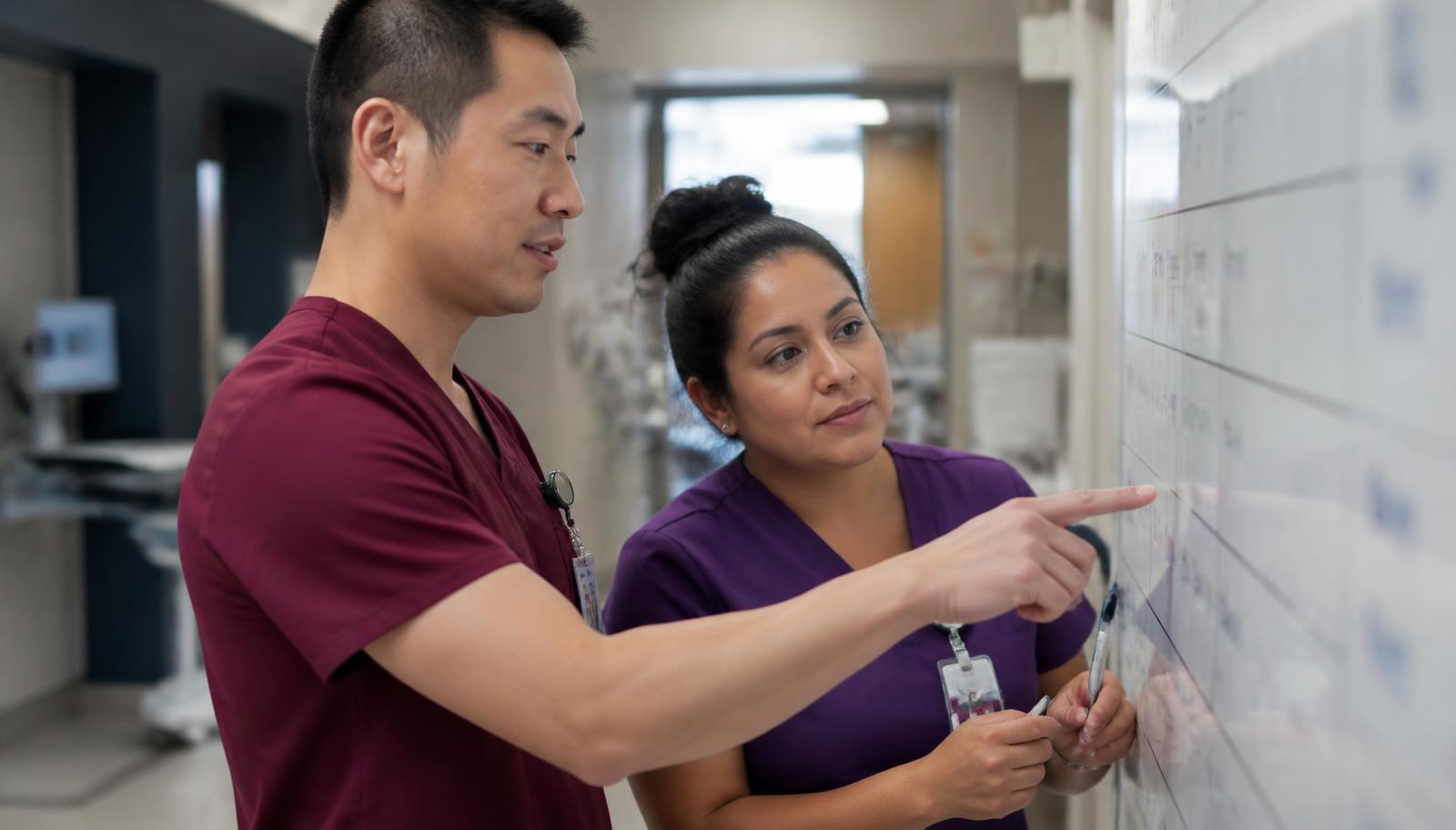
Two nurses reviewing a hospital unit assignment whiteboard together
Sprint · scenario 2

Order your first four actions

  • New chest pain, 2 out of 10, no ECG yet.
  • Scheduled antibiotic due 20 minutes ago.
  • Family asking for a discharge update.
  • Aide reports a patient found sitting on the floor.
Sprint · scenario 2

Scenario · 1512

Four demands, one of you, and a charge nurse who is also busy.

Prioritization Sprint asks you to sequence, then explain your reasoning, then reassess after new information arrives. There is rationale, delegation, and a reassessment prompt — not a single “correct” answer key.

See Prioritization Sprint

Scenario · 1848

You are being handed a fifth admission and you already owe two assessments.

Shift Boundary Builder gives you professional, safety-centered language: what you can carry, what you cannot, what you need in order to take it, and how to escalate through your chain of command.

See Shift Boundary Builder
Two nurses talking calmly in a hospital hallway
Script builder · workload

Say it once, clearly

  • I can take the admission if someone covers the 1900 assessments.
  • Right now I have two assessments outstanding and one unstable patient.
  • If neither is possible, I need you to help me decide what waits.
Script builder · workload

Educational scope

These are teaching tools for practice and preparation.

Nursing Beyond Theory is educational. It does not replace employer policy, your own clinical judgment, supervision, provider orders, scope of practice, emergency procedures, or local chain-of-command requirements. Follow your employer's policy and escalate or seek support as appropriate.

Who made this

Written from the bedside, not from a curriculum committee.

Created by a master's-prepared Registered Nurse with Labor & Delivery and case-management experience.

Every tool here started as a moment on a real shift where the right words were not obvious, and it takes the form it does because that is what would have helped in the moment.

About + scope and safety

Pick the shift problem you want to be ready for.

3 tools available now, three more in development.

Explore the tools